

You probably think every over in Test cricket has always been 6 balls. Most fans do.
But the very first Test match in 1877 had just 4 balls in an over.
That is the real answer.
Here is the full, simple story of how the number changed over time. I will show you every step, why it happened, and what it means today. No hard words, just clear facts.
The Very First Test Matches: Only 4 Balls
The first Test ever was Australia vs England in Melbourne, 1877. Bowlers sent down 4 balls, then the umpire called “Over!”
This stayed the rule from 1877 to about 1889 in most places. Charles Bannerman faced the very first ball in Test history under these 4-ball rules.
Why only 4? Cricket was still growing. Games felt slow if bowlers changed ends too often. Four balls let the game move quicker. But players soon saw problems.
Why Did They Start With Just 4 Balls?
- Bowlers could not get into a good rhythm.
- Ends changed every 4 balls, so fielders ran back and forth a lot.
- Matches lost time.
Captains and officials said, “Let’s try more balls so the game flows better.”
The Experiments: They Tried 5 Balls, Then 8 Balls
Countries did not all agree at first. Each host nation picked its own number. This caused confusion for players and fans.
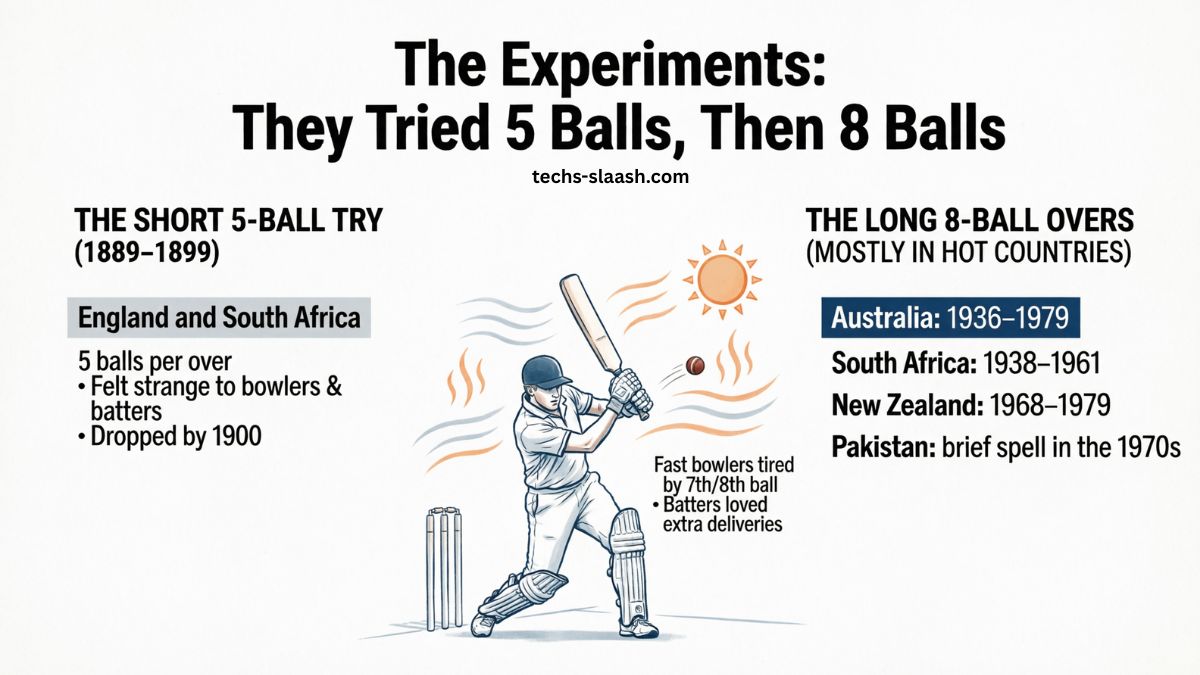
The Short 5-Ball Try (1889–1899)
England and South Africa tried 5 balls per over. It felt strange to everyone. Bowlers and batters said it was not right. By 1900 most places dropped it.
The Long 8-Ball Overs (Mostly in Hot Countries)
Australia, South Africa, New Zealand and Pakistan used 8 balls at different times.
- Australia: 1936–1979
- South Africa: 1938–1961
- New Zealand: 1968–1979
- Pakistan: brief spell in the 1970s
Fast bowlers like Dennis Lillee and Jeff Thomson bowled these long overs in the heat. They got very tired by the 7th and 8th ball. Batters loved the extra balls to face one bowler.
England Usually Stuck With 6 Balls
England used 6 balls most of the 1900s (after the short 5-ball test). It felt balanced. Bowlers got a good rhythm. Games moved at a nice speed.
1979: The Whole World Finally Picks 6 Balls
In the 1979–80 season the ICC (world cricket bosses) said: “From now on, every Test match uses 6 balls per over.”
This rule is still in place today. No more changes by country. Everyone plays the same way.
Read: Retrieving Data. Wait a Few Seconds” Excel Error – Easy Fixes That Actually Work
Why 6 Balls Is Just Right (The “Goldilocks” Number)
Think of the story of Goldilocks – not too little, not too much. Six balls is perfect because:
- Bowlers get time to settle into their line and length (unlike 4 balls).
- Fast bowlers do not get too tired (unlike 8 balls).
- The game flows nicely for fans and TV.
- It fits breaks for ads and lunch.
Players and umpires all agree: 6 feels natural.
Full Timeline: Balls Per Over in Every Major Country
Here is a clear table so you can see exactly what happened:
| Country | Years | Balls per Over |
|---|---|---|
| England | 1880–1888 | 4 |
| England | 1890–1899 | 5 |
| England | 1902–1938 | 6 |
| England | 1939–1945 | 8 |
| England | 1946–today | 6 |
| Australia | 1877–1888 | 4 |
| Australia | 1892–1921 | 6 |
| Australia | 1924–25 | 8 |
| Australia | 1929–1933 | 6 |
| Australia | 1937–1979 | 8 |
| Australia | 1980–today | 6 |
| South Africa | Before 1889 | 4 |
| South Africa | 1889–1899 | 5 |
| South Africa | 1899–1938 | 6 |
| South Africa | 1938–1961 | 8 |
| South Africa | 1962–today | 6 |
| New Zealand | 1929–1968 | 6 |
| New Zealand | 1968–1979 | 8 |
| New Zealand | 1980–today | 6 |
| Pakistan | 1955–1973 | 6 |
| Pakistan | 1973–1978 | 8 |
| Pakistan | 1979–today | 6 |
| India, West Indies | Mostly from start | 6 |
You can see Australia used 8 balls the longest!
How Different Over Lengths Changed the Game
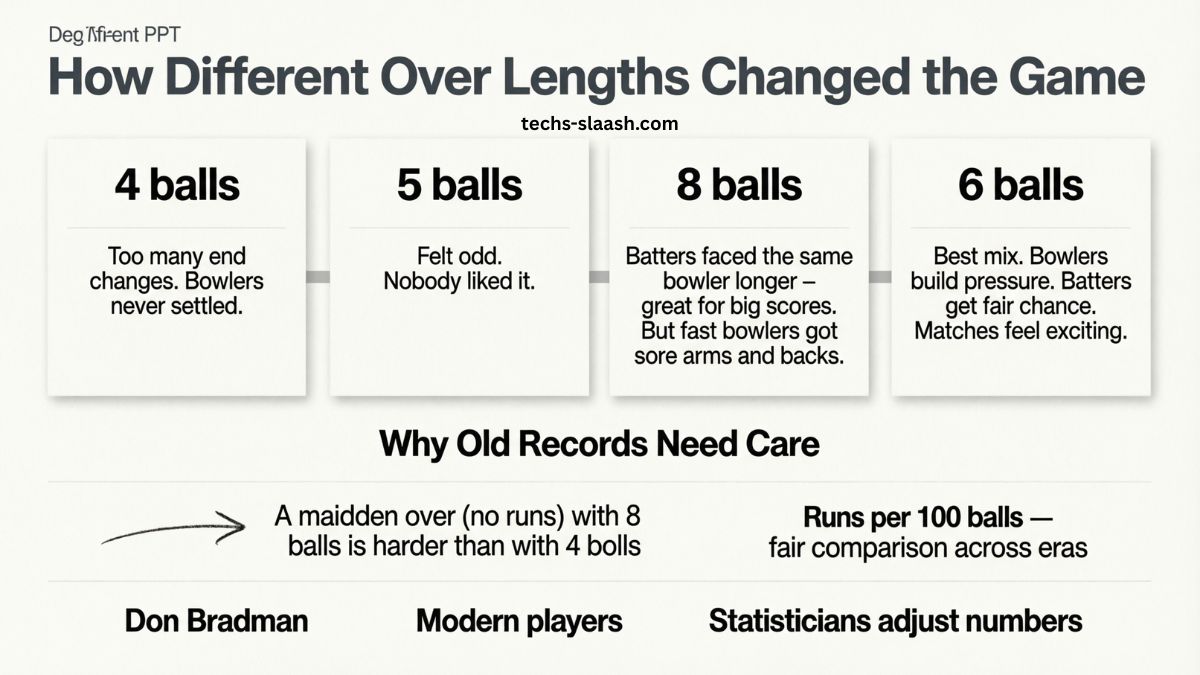
- 4 balls: Too many end changes. Bowlers never settled. Scoring was quick but messy.
- 5 balls: Felt odd. Nobody liked it.
- 8 balls: Batters faced the same bowler longer – great for big scores. But fast bowlers got sore arms and backs.
- 6 balls: Best mix. Bowlers build pressure. Batters get fair chance. Matches feel exciting.
This is why old records need care. A maiden over (no runs) with 8 balls is harder than with 4 balls. Statisticians often change numbers to “runs per 100 balls” so we can compare Don Bradman (who faced many 8-ball overs) with modern players fairly.
Overs That Went Crazy Long: Extras Made Them Huge
Even today an over can go longer than 6 balls because of wides and no-balls.
Famous Test example: Curtly Ambrose bowled 15 balls in one over against Australia in 1997 (9 no-balls!).
Other crazy overs happened with 14, 15, 17 balls – all because of extras. The bowler still only counts 6 legal balls, but fans see many more deliveries.
No official Test over ever started as 10 balls. The longest planned was 8.
What About Today and the Future?
Right now every Test uses exactly 6 balls per over. The same rule is in ODIs and T20s too.
Will it ever change again? Probably not. Six works perfectly for players, fans, TV, and fairness. The ICC has kept this rule for over 45 years and everyone is happy.
Frequently Asked Questions
How many balls were originally in one Test over? 4 balls. The first Test in 1877 used 4-ball overs.
When did 6 balls become the rule everywhere? From the 1979–80 season. The ICC made it the same for all countries.
Did any country ever use 10 balls? No. The longest planned over was 8 balls. Overs only get longer when there are wides or no-balls.
Why did Australia stop 8-ball overs? To match the rest of the world and because 6 balls is easier on bowlers and better for TV.
Does over length change old records? Yes. An 8-ball maiden is harder than a 4-ball maiden. Experts adjust the numbers to compare fairly.
Do T20 or ODI matches use different numbers? No. All international cricket now uses 6 balls per over.
Why not go back to 4 or 8 balls? 4 balls make the game too stop-start. 8 balls tire bowlers too much. 6 is the sweet spot.
Has the law ever changed because of a mistake? The 1980 Laws of Cricket officially wrote “6 balls” for the first time. Before that, captains just agreed on the number.
Can an over today ever have more than 6 balls? Yes – only because of extras (wides and no-balls). The bowler must bowl until 6 legal balls are done.
Will the number ever change in the future? Unlikely. Six balls has worked great for more than 45 years.
Conclusion
The original number of balls in one Test over was just 4 when cricket’s longest format began in 1877. Over the decades, rules evolved through experiments with 5-ball and especially 8-ball overs in countries like Australia, South Africa, and others—until the ICC standardized 6 balls per over worldwide starting in the 1979–80 season. This “Goldilocks” number—neither too short nor too long—strikes the perfect balance: it gives bowlers time to build rhythm and pressure, spares fast bowlers from excessive fatigue, keeps the game flowing smoothly for players and fans alike, and has remained unchanged for over 45 years. Today, every Test match follows this simple, effective 6-ball rule, making the early 4-ball days a fascinating reminder of how cricket grew into the global sport we love.
