

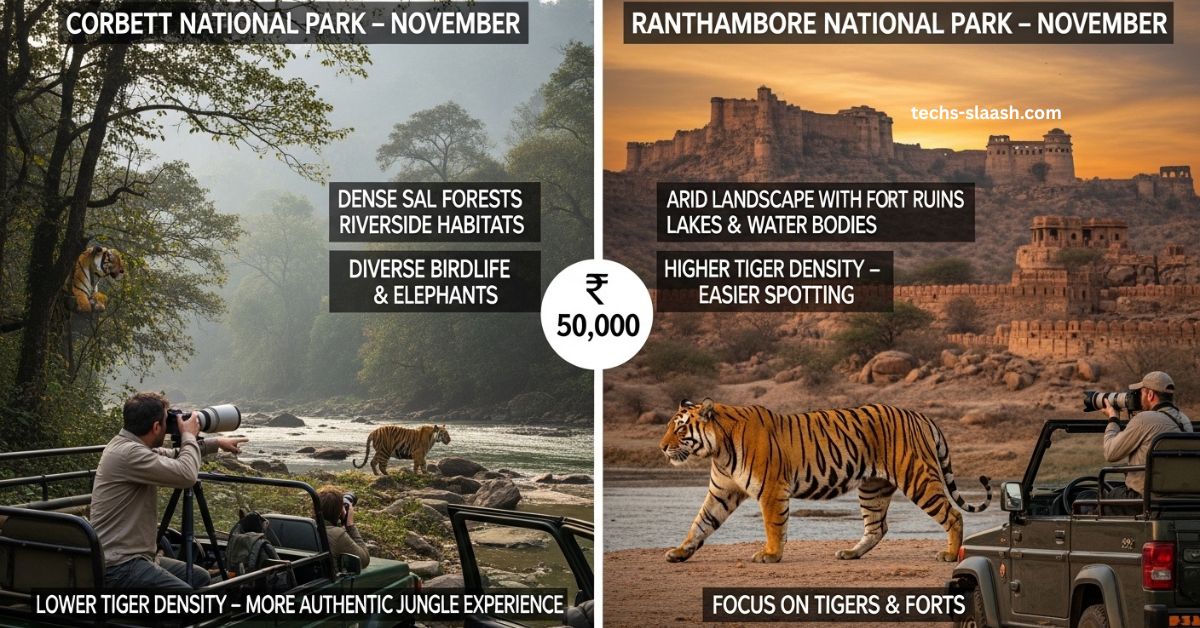
You have 5 days. You have ₹50,000. And you want great wildlife shots.
Two parks come to mind: Jim Corbett and Ranthambore. Both have tigers. Both are open in November. But they give you very different photos.
This guide breaks down both parks — zone by zone, cost by cost — so you can pick the right one for your camera bag.
Why November Is the Best Month for Both Parks?
Before we compare, let’s talk about timing. November is a smart pick. Here’s why:
- Monsoon is over. The land is green and fresh. Backgrounds look great in photos.
- Animals are active. Cooler air means animals move longer in the morning and evening.
- Light is soft. The sky is clear. Golden hour lasts longer. Your shots look cleaner.
- Crowds are lower than December–February. You get quieter safaris.
- Water sources shrink. Animals gather near lakes and rivers. Easier to find them.
One extra note for Corbett fans: the famous Dhikala Zone reopens in mid-November after the monsoon closure. If you plan your trip for the last two weeks of November, you can get inside this premium zone.
Quick Snapshot: Corbett vs Ranthambore at a Glance
| Feature | Jim Corbett | Ranthambore |
|---|---|---|
| Location | Uttarakhand | Rajasthan |
| Distance from Delhi | ~250 km | ~400 km |
| Tiger Sighting Odds | Moderate | High |
| Wildlife Variety | Very High | Moderate |
| Forest Type | Dense sal + river | Open scrub + lakes |
| Best For | Diversity, birds, mood | Tiger portraits |
| Budget Stretch | Easier | Slightly higher |
| Beginner-Friendly | Moderate | Yes |
| Dhikala Zone | Opens mid-November | N/A |
The Core Difference (What Most Guides Miss)
Most articles tell you “Ranthambore is for tigers, Corbett is for variety.” That’s true. But there’s more to it.
The real question is: what does success look like in your camera roll?
At Ranthambore, your frames will be bold and clean. Open land, bright light, tigers near lakes. One strong image per outing is very possible.
At Corbett, your frames will be layered and atmospheric. Mist, rivers, elephants, birds. You build a story across your 5 days, not just one hero shot.
Both are valid. Neither is wrong. But they ask different things from you as a photographer.
Jim Corbett National Park: What to Expect?
Wildlife You Can Shoot
Corbett is India’s oldest national park. It sits in the Himalayan foothills. This gives it a rich mix of animals.
- Bengal tigers (harder to spot in dense forest, but magical when you find one)
- Asian elephants (large herds near Dhikala)
- Leopards
- Sloth bears
- Gharials and mugger crocodiles on the Ramganga riverbanks
- 600+ bird species — great hornbills, pied kingfishers, and more
- Spotted deer, sambar, wild boar
November tip: Early morning mist near the Ramganga River creates stunning silhouettes. Bring your 400mm+ lens for birds on the water.
Best Zones in Corbett for Photography
Not all zones are equal. Here’s the honest breakdown:
| Zone | What You Get | Open in November? |
|---|---|---|
| Dhikala | Best tiger & elephant coverage. Wide grasslands. | From mid-November |
| Bijrani | Very popular. Good tiger sightings. Compact zone. | Yes |
| Jhirna | Open year-round. Good leopard and sloth bear chances. | Yes |
| Dhela | Newer zone. Less crowded. Good birding. | Yes |
| Sitabani | Buffer zone. No permit needed. Great for bird photography. | Yes |
Best pick for photography: Dhikala if you go after Nov 15. Bijrani if you go earlier.
Photography Style at Corbett
Corbett rewards patience. You won’t always see tigers right away. But you’ll shoot elephants crossing rivers, kingfishers diving, and deer in golden grass.
Your portfolio will look diverse. It tells a wildlife story, not just a tiger story.
Ranthambore National Park: What to Expect?
Wildlife You Can Shoot
Ranthambore is smaller and more open than Corbett. That’s actually good for photography.
- Bengal tigers — highest visibility in India’s major reserves
- Leopards (rocky terrain near the fort is perfect)
- Sloth bears (often seen near the tracks digging for termites)
- Jungle cats, hyenas, jackals
- Crocodiles at Padam Talao lake
- Deer, nilgai, wild boar
- Painted storks and other water birds at the lakes
November tip: Tigers visit the lakes — especially Padam Talao — more often as it cools down. Position your jeep early near the waterhole for high-action frames.
Best Zones in Ranthambore for Photography
Ranthambore has 10 zones. Zones 1–5 are core zones. Zones 6–10 are buffer zones.
| Zone | What You Get | Tip |
|---|---|---|
| Zone 2 | Highest tiger activity. Near the lake. | Book 90 days in advance |
| Zone 3 | Beautiful lakes. Great for water-side tiger shots. | Best for dramatic frames |
| Zone 4 | Good variety. Less competitive. | Good backup choice |
| Zone 1 | Fort ruins backdrop. Cinematic shots. | Great for landscape + tiger combo |
| Zone 5 | Reliable sightings. Popular with photographers. | Evening light is excellent here |
Best pick for photography: Zone 2 or Zone 3 for tigers near water. Zone 1 for iconic fort + wildlife frames.
Photography Style at Ranthambore
Ranthambore rewards decisive moments. Tigers here are used to vehicles. They don’t run. You get close. You get clean frames.
The ancient fort ruins add a backdrop you won’t find anywhere else in India. One frame — tiger, lake, old stone wall — and your trip feels complete.
Budget Breakdown: ₹50,000 for 5 Days
This is the real test. Let’s look at both parks honestly.
Corbett — 5-Day Budget Plan (Starting from Delhi)
| Expense | Cost |
|---|---|
| Train Delhi → Ramnagar (return) | ₹1,500–₹2,500 |
| Local transfer (station to resort) | ₹500–₹800 |
| Mid-range stay near Bijrani (4 nights) | ₹10,000–₹14,000 |
| 6 safaris × ₹2,500 avg | ₹14,000–₹16,000 |
| Meals (₹500/day × 5) | ₹2,500 |
| Misc (entry fees, tips, water) | ₹2,000 |
| Total Estimate | ₹30,500–₹37,800 |
Remaining budget: ₹12,000–₹19,500. That’s room for one better zone like Dhikala (full-day safari costs more) or a camera gear hire.
Ranthambore — 5-Day Budget Plan (Starting from Delhi)
| Expense | Cost |
|---|---|
| Train Delhi → Sawai Madhopur (return) | ₹2,500–₹4,000 |
| Local transfer (station to resort) | ₹400–₹600 |
| Mid-range stay near park (4 nights) | ₹12,000–₹16,000 |
| 6 safaris × ₹2,800 avg (core zones cost more) | ₹15,000–₹18,000 |
| Meals (₹500/day × 5) | ₹2,500 |
| Misc (entry fees, tips, water) | ₹2,000 |
| Total Estimate | ₹34,400–₹43,100 |
Remaining budget: ₹7,000–₹15,600. Still workable, but tighter. Core zone permits in Ranthambore cost more and must be booked well in advance.
Budget winner: Corbett. It gives you more safaris for the same money.
Day-by-Day Itinerary: 5 Days in Each Park
Corbett — 5-Day Photography Itinerary
Day 1: Travel from Delhi to Ramnagar. Check in near Bijrani gate. Evening walk outside the buffer zone. Rest.
Day 2: Morning safari in Bijrani. Golden light through the sal trees. Evening safari same zone or Dhela. Focus on birds and deer in late light.
Day 3: Full-day Dhikala (if available after Nov 15). Pack lunch. This is your big wildlife day — elephants, tigers, open grassland. Best light at 6–8 AM and 4–6 PM.
Day 4: Morning safari at Jhirna. Good leopard and sloth bear chances. Afternoon: Kosi riverbank for crocodile and bird shots.
Day 5: Early morning Sitabani buffer zone walk. No safari vehicle — you walk. Great for forest birds and insects. Depart post-lunch.
Ranthambore — 5-Day Photography Itinerary
Day 1: Train to Sawai Madhopur. Check in. Explore the town and fort views from outside. Rest early.
Day 2: Morning safari Zone 2 or Zone 3. Go straight for the lakeside spots. Stay quiet in the jeep. Evening safari Zone 5 — excellent golden hour light.
Day 3: Morning safari Zone 1 for the fort backdrop. Best for unique, cinematic compositions. Evening: revisit Zone 3 for waterhole action.
Day 4: Morning safari Zone 2 again. Tiger patterns repeat — your guide will know if a tiger was seen near Padam Talao. Best chance for action shots.
Day 5: Early morning safari. Check out by noon. Train back to Delhi.
Gear Tips: What to Pack for Each Park?
You don’t need to spend more. You just need the right gear for each terrain.
For Corbett
- Long lens (400mm+): Forest is dense. You need reach.
- Fast autofocus body: Animals appear and vanish fast in thick cover.
- Polarizer filter: Rivers and streams reflect beautifully.
- Waterproof cover for gear: Morning mist near the river is real.
- Extra memory cards: You’ll shoot birds all day.
For Ranthambore
- 400–500mm lens: Tigers in open land. You want to fill the frame.
- Beanbag or window mount: All shots happen from the jeep. No tripod.
- Dust protection: Ranthambore is dry. Dust gets into everything.
- Wide lens (24–70mm): Fort ruins + landscape shots need wider angles.
- Extra batteries: Long safaris, cold mornings drain batteries fast.
3 Things Competitors Don’t Tell You
1. Zone Assignment Can Make or Break Your Trip
At Ranthambore, you don’t always choose your zone. Sometimes zones are assigned at booking. If you get Zone 6–10 (buffer), tiger chances drop a lot. Book core zones (1–5) directly through the forest department, 90 days in advance. Don’t rely on agents who promise zones they can’t guarantee.
2. Dhikala Timing Changes Everything at Corbett
The Dhikala zone is Corbett’s best. But it opens only in mid-November. If you go in early November, you miss it. Plan your travel for November 20 or later to get full access. This one change can upgrade your Corbett trip from “good” to “great.”
3. Your Guide Matters More Than the Park
A good naturalist guide changes what you see and how fast you see it. In both parks, experienced guides read animal behavior, know patrol routes of tagged tigers, and position vehicles for the best light angles. Pay extra for a certified naturalist guide. It’s worth every rupee.
Who Should Pick Ranthambore?
Go to Ranthambore if:
- You want a strong tiger portrait in your portfolio
- You’re a beginner and want easier sightings
- You shoot with a 400–600mm prime lens and prefer clean backgrounds
- You love dramatic, cinematic compositions (tiger + ancient fort)
- You have slightly more budget flexibility
Who Should Pick Corbett?
Go to Corbett if:
- You want a diverse wildlife story — not just tigers
- You love bird photography (600+ species is not a small number)
- You enjoy misty, atmospheric, layered shots
- You’re on a tighter budget
- You want fewer crowds and a quieter jungle experience
Conclusion
choosing between Jim Corbett National Park and Ranthambore National Park comes down to what you want in your camera roll: if your goal is a bold, close-up tiger shot with high success rates, Ranthambore is the smarter pick, but if you’re after a richer, more diverse wildlife story with elephants, birds, rivers, and atmospheric forest scenes, Corbett delivers far more variety within the same ₹50,000 budget. Both parks are excellent in November, so align your choice with your shooting style, book the right zones early, and focus on maximizing your time in the field—because in wildlife photography, patience and positioning matter just as much as the destination.
Frequently Asked Questions
Q: Which park has more tiger sightings in November? Ranthambore has higher tiger sighting rates in November. The open terrain makes tigers easier to spot. Corbett has tigers too, but the dense forest makes sightings less predictable.
Q: Is ₹50,000 really enough for a 5-day trip? Yes. Both parks fit within ₹50,000 if you travel by train, stay at mid-range lodges, and book safaris through official channels. Corbett gives you more buffer. Ranthambore is tighter but doable.
Q: When exactly does Dhikala zone open in November? Dhikala typically reopens in mid-November after the monsoon closure — usually around November 15. Always check the official Corbett park website before booking, as dates shift slightly each year.
Q: How far in advance should I book safari permits? For Ranthambore core zones (1–5), book 90 days in advance. They sell out fast in November. For Corbett zones like Bijrani and Jhirna, 30–60 days ahead is usually enough. Dhikala needs earlier booking too.
Q: Which park is better for bird photography? Corbett is significantly better for bird photography. With 600+ species — including hornbills, kingfishers, eagles, and rare Himalayan birds — it’s one of India’s top birding spots.
Q: Can I visit both parks in 5 days? It’s tight but possible if you keep travel days short. Train from Delhi to Sawai Madhopur (Ranthambore) is about 5–6 hours. From there to Ramnagar (Corbett) takes 10–12 hours. Spend 2 nights at one and 2 nights at the other, using the last day for travel. You’ll need to plan carefully and keep activities focused.
Q: Do I need a special camera permit inside the parks? No special permit is needed for personal camera use inside the jeep during safaris. Some parks charge a small camera fee (₹200–₹500) at entry. Video and professional commercial shoots need prior permission from forest authorities.
Q: What should I wear on a November safari? Layers. Mornings can drop to 8–12°C in both parks in November. Afternoons warm up to 22–26°C. Wear neutral colors — khaki, olive, or beige. Avoid bright colors or white. Carry a light fleece for early morning drives.